English mp3 today
Wednesday, January 14, 2009Five Cambodian women repatriated from Taiwan by NGO [-The curse of arranged marriage]
14 Jan 2009
By Leang Delux
Cambodge Soir Hebdo
Translated from French by Tola Ek
Click here to read the article in French
Since the beginning of the month, they have returned back to the kingdom one after another, following several years spent in Taiwan. The five women, between their 20s and 40s, have known the same misfortune. Their repatriation was organized by the CARAM (Coordination of Action Resarch on Aids and Mobility) NGO led by Ya Navuth.
The women’s stories were all sad. Send to Taiwan though arranged marriage, they were instead put on sale there and sustained physical abuse.
Sophea, a 34-year-old native of Kratie, spent 3-1/2 years away from home, working at a plastic cup manufacturing company. During a police raid at the factory, she was able to explain her situation to the cops who released her.
Two other women are about to return back also, but their family issue, linked to children they borne to Taiwanese citizens, make their cases more complicated.
Between 2000 and 2008, CARAM Cambodia had repatriated 200 women who fell prey to trafficking and were sent to Malaysia, Thailand, etc…
Read more!
Cambodian film star Dy Saveth nears half a century in the biz

 Dy Saveth today (Top), and a photo of the popular actress in her role in Sak Pos, or Snake Hair (Bottom). (Photo by: Sovann Philong)
Wednesday, 14 January 2009
Written by Mom Kunthear
The Phnom Penh Post
She's been an actress since 1960, when she won Cambodia's first beauty pageant, and shows no signs of quitting. Her most recent role was in the short film In Drama, about ‘love and war'
Renowned Cambodian film star Dy Saveth, 64, has been acting since 1960, getting her start at the age of 16 after winning Cambodia's first beauty pageant the year before.
Her distinguished career began by chance when a movie producer approached her.
Being one of the most recognisable faces in Cambodia, Dy Saveth fled the country for France when the Khmer Rouge came to power in 1975. Prior to leaving, she and her then-husband Huoy Keng ran a movie production company.
In 1975 they separated - Huoy Keng escaped to Hong Kong - and were later divorced.
Together the pair have two children, and Dy Saveth has since adopted two more. A big family suits the actress, who was herself one of seven children.
Dy Saveth's return to Cambodia in 1993 was greeted with shock, as most people had presumed that she - like most other actors of her generation - had been killed by the Khmer Rouge or died as a result of their rule.
She resumed her career on screen and continues to appear in numerous projects. Currently, she is a professor of fine arts at the Royal University of Phnom Penh, where she works to inspire a new generation of Khmer actors.
What was the first film you acted in?
Dy Saveth: The first movie I performed in was Kboun Chivit (Raft Life). Initially, I didn't want to act in films, but the movie producer of Kboun Chivit contacted my sister and asked her if I would be willing to act in their film. I was very lucky that this was the first film I was in because it has a good story line and the audience liked it."
"I noted down all films I was in, but I lost the book during the pol pot regime."
What were the difficulties you encountered when you first started acting?
Dy Saveth: I didn't really know how to act when I first started my career, but I tried very hard to learn and I believe that's why I achieved success. I teach acting now, and I usually tell my students to focus on what they are doing because if they just listen without concentrating and practicing, they will not succeed. I teach my students for free because when I first started out, the audience really supported me and now I want to return this kindness. I don't have much money or property to give them. I only have my acting knowledge to pass on to those who want to learn.
How many films have you been in?
Dy Saveth: I have acted in around 100 films. I noted down all films I was in, but I lost the book during the Pol Pot regime. Pos Kengkorg (The Python) and Sak Pos (Snake Hair) were the turning point, as the films made me very famous both locally and internationally.
How do you compare today's films to the films of the past?
Dy Saveth: All movie producers, writers and cameramen learned their craft at school in the past, except for the actors and actresses who listened to the producers' lead. Now, [they] learn the skills from each other. I never complained when I had to work very hard because I believed that at the end I would achieve success. I was lucky enough to work with good scriptwriters who tried to make each film different. Today, many actors and actresses are afraid of experiencing difficulties.
How many international movie stars have you worked with?
Dy Saveth: I have performed with Thai, Taiwanese, Korean, Indonesian and Chinese actors. King Sihanouk wrote and directed four films that I have appeared in. My latest film, In Drama, was filmed last year. It is a 30-minute story about love and war, and it hasn't been released on TV yet.
How do you keep yourself looking so young?
Dy Saveth: I try to avoid unhappy things that make me feel depressed. Also, I think carefully about the type of food I eat to stay healthy and drink plenty of water.
Read more!
Kiss and tell case?
 18-month jail sentence for a kiss
14 Jan 2009
By Ung Chamroeun
Cambodge Soir Hebdo
Translated from French by Tola Ek
Click here to read the article in French
25-year-old Kim Koun received the sentence for sexual harassment following a complaint raised by a 20-year-old woman. According to the Rasmey Kampuchea newspaper, the plaintiff accused Kim Koun of planting a kiss on her while the pair did not even know each other. In front of the judge, the accused man did not hide the facts. However, he explained that in April 2008, the young woman used his service to travel to several places. “I asked her for the fees owed for the transport service, but she told me that she had no money. I decided to give her a kiss in lieu of the fees,” Kim Koun argued. In spite of these details, he was nevertheless handed down an 18-month jail sentence for sexual harassment. The amount of monetary compensation has not been fixed yet.
Read more!
Civil Society Calls for Investigation of Further Suspects by the ECCC
STATEMENT
Civil Society Calls for Investigation of Further Suspects by the ECCC
Civil Society Calls for Investigation of Further Suspects by the ECCC
Phnom Penh, 14 January 2009
In response to statements from the Co-Prosecutors issued 8th December 2008, and 5th January 2009 we, the Cambodian Human Rights Action Committee (CHRAC), a coalition of 21 NGOs, call on the Extraordinary Chambers in the Courts of Cambodia (ECCC) to act independently and exercise its mandate by investigating further individuals who have main responsibility for the crimes of the Khmer Rouge regime. We believe a failure to do so will undermine the impact and legacy of the court. Victims of the Khmer Rouge regime have already had to accept the limited mandate of the ECCC due to the realties of transitional justice; they will not however accept a failure of the court to properly exercise its existing powers and responsibilities.
According to the Co-Prosecutors statement of 5th January 2009 the National Co-Prosecutor considers further judicial investigations should not take place against additional suspects due to considerations of 1) the need for stability and national reconciliation, 2) the spirit of the Agreement between the UN and Royal Government of Cambodia (“Agreement”) and subsequent ECCC law, and 3) the limited time and budget available to the court. We do not consider these factors to in anyway bar judicial investigation of further suspects.
The ECCC was established in order to deliver justice and promote national reconciliation by prosecuting senior leaders and those most responsible for the crimes of the Democratic Kampuchea regime. The Agreement and ECCC Law are specifically designed to ensure that the need for justice is balanced with the need to promote transitional stability and national reconciliation. Contrary to previous concerns the arrest and action against the current 5 suspects has not led to instability and there is simply no credible evidence that the prosecution of a similar number of further suspects would risk Cambodia’s stability, or national reconciliation. The Agreement and ECCC Law are the guardians of the needs of stability and national reconciliation and not individual officers of the ECCC. We are aware that the needs of justice must be balanced with those of stability and in order to counter any residual concerns within Cambodia relating to further action against former Khmer Rouge we call for the court to make a final and comprehensive move against all remaining suspects. This will ensure that former Khmer Rouge not subject to the proceedings at the ECCC know that they have nothing to fear and ensure that their cooperation is secured.
We believe that the ECCC should not limit itself beyond the restrictions on its powers of prosecution in the Agreement and ECCC Law. The Agreement and ECCC Law are clear that the ECCC should bring to trial senior leaders of Democratic Kampuchea and those who were most responsible for the crimes of the regime. Given that the Co-Prosecutors have identified further individuals suspected as being most responsible we consider it proper that the ECCC proceed with judicial investigations of those suspects.
We do not believe that the ECCC should arbitrarily limit itself to 5 prosecutions. If there are credible suspicions that there are individuals guilty of crimes falling within the tribunal’s mandate then they should be judicially investigated without delay. It is this course of action best reflects the spirit of the of the Agreement and ECCC law.
Furthermore we consider that the successful and full completion of the court’s mandate should take precedence over short term considerations of budget and time. If at the end of life of the ECCC, and despite the huge expense of establishing and running the court, it has failed to prosecute all surviving senior leaders and those with greatest responsibility then this investment will be seen to have been largely wasted. We believe the ECCC has the ability to undertake investigations and trials of further suspects and believe that donors will be willing to support these actions if further resources are necessary for the ECCC to succeed in achieving its goals.
We consider it in the interests of justice, national reconciliation and thus future stability that senior leaders and those most responsible for the crimes of the Khmer Rouge regime are brought to account at the ECCC. Without further prosecutions the ECCC will fail to deliver justice to the people of Cambodia and damage efforts to create genuine reconciliation. We fear that the efforts and achievement of the Cambodian government and people, and the international community in creating the ECCC will be squandered if the court is seen to only partially fulfill its mission.
We urge all stakeholders in the ECCC process, including the Royal Cambodian Government and the international community, to ensure that the court is able to act independently and free of political interference or consideration, and give it full support as it acts to fulfill its mission.
For further information or comment please contact:
Mr. SOK Sam Oeun, Chairman of CHRAC, Executive Director of CDP; Tel: 012 901 199
Mr. THUN Saray, President of ADHOC; Tel: 016 880 509
Ms. SENG Theary, Executive Director of CSD; Tel: 012 222 552
Mr. HANG Chhaya, Executive Director of KID; Tel: 012 865 910
End.
Read more!
Court Officials Set for Four-Year Rotation
By Sok Khemara, VOA Khmer
Original Report from Washington
14 January 2009
“Every four years, or a little bit more, there needs to be a change to another place,” Justice Minister Ang Vongwatana said. “Those who are in the same place for a long time, they know all the people, the chief of the court knows all the people, knows the businessmen, and the businessmen know them.”
Friendships grow and make work difficult, he said. “So that’s why there is the principal that they should not stay in one place.”
Cambodia’s courts face continual criticism of political bias and corruption, and donors have pushed for reform, something court officials say they are working on.
No details were immediately available on changes at Phnom Penh Municipal Court, where many of the country’s key trials are held, but Ang Vongwatana said around four or five judges and prosecutors would be moved.
An observer close to the Supreme Council of Magistracy said Tuesday Phnom Penh court’s chief prosecutor, Ouk Savuth, would be moved to the Appeals Court, as deputy-general prosecutor, while his deputy, Yet Chakrya, would replace him.
Yet Chakrya was transferred from Banteay Meanchey provincial court and currently serves as a reserve prosecutor for the Khmer Rouge tribunal.
Read more!
Cambodia receives $84.7 million grant from World Bank, aid donors
In a press statement, the World Bank said $52.1 million is earmarked for improving the health of underprivileged mothers and children, $20 million for projects aimed at improving the government's accountability and responsiveness to public needs, and $12.6 million for removing trade barriers and improving the standard of Cambodian exports.
Deputy Prime Minister and Minister of Economy and Finance Keat Chhon pledged the Cambodian government will "utilize these grants in an efficient, accountable and transparent manner."
World Bank Country Director Annette Dixon said she hopes the grants will give crucial support to the Cambodian government's efforts to reduce poverty and ensure Cambodians enjoy secure and sustainable livelihoods.
Apart from the World Bank, other donors that contributed to the grants include Britain, Australia, Denmark, the European Commission and the U.N. Industrial Development Organization.
Read more!
Cambodia "continued its drift toward authoritarianism" as Hun Sen consolidated power: HRW
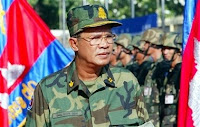 Conflicts, crackdowns mar 2008 Asian rights record: HRW
In its annual report for 2008, the New York-based group detailed worsening trends in much of Asia, including China's Olympic-year crackdown on civil liberties and its repression of protests across the Tibetan plateau.
Wars turned more bloody in Afghanistan, which saw the "worst violence since the fall of the Taliban," and Sri Lanka, where the government last January formally scrapped a ceasefire with the separatist Tamil Tigers.
Conflicts also flared up again in less-watched hotspots, including Muslim regions of Thailand and the Philippines, while Indonesian forces in remote West Papua "continue to engage in abuses ... with virtual impunity," it said.
HRW pointed to some progress in parts of South Asia, including the return to civilian rule in Pakistan after the end of the Pervez Musharraf presidency, and improvements ahead of polls in Bangladesh last month.
Elections in Nepal, where Maoists took power and the king abdicated, "marked a new era... after a decade of conflict that claimed over 13,000 lives."
But HRW also highlighted tighter restrictions on freedom of association, expression and religion in China, which it said "broke its promise to improve human rights in conjunction with its hosting of the 2008 Summer Olympic Games."
In Tibet, where simmering anger against Chinese rule erupted into major protests last March, HRW said that following mass arrests of suspected demonstrators the whereabouts of several hundred detainees remained unknown.
HRW also criticised Asia's other population giant, India, for "serious abuses," including in the disputed Himalayan region of Kashmir, which was again rocked by major unrest in 2008.
The report pointed to India's "pattern of denial of justice and impunity" and a "failure to protect women, children and marginalized groups such Dalits, tribal groups and religious minorities."
India, as an emerging global player, was now often placing economic and strategic interests over rights concerns as it tried to compete with China in countries such as Myanmar, said HRW.
"As the world's most populous democracy, India might be expected to be at the forefront of global efforts to promote human rights," it said. "However, its current foreign policy often would make a confirmed dictator proud."
In Myanmar, also known as Burma -- which HRW said also draws support from China, Russia and Thailand -- democracy leader Aung San Suu Kyi went into her sixth straight year of house arrest, one of over 2,150 political prisoners.
"The Burmese military continues to violate the rights of civilians in ethnic conflict areas and extrajudicial killings, forced labour, land confiscation without due process and other violations continued in 2008," said the report.
When Cyclone Nargis struck the country last May, "more than two million people waited for weeks for relief operations to reach them" after the reclusive regime denied access to foreign aid groups.
Life in Asia's other hermit state, North Korea, remained even more dire, with the regime continuing to "enslave" citizens in prison camps and executing people for crimes that include hoarding food, said the report.
Reports that leader Kim Jong-Il suffered a stroke in September "could have far-reaching consequences for human rights and governance," the group said.
Across much of Southeast Asia, human rights were also on shaky ground.
In Thailand "the end of a military-installed administration has not led to the restoration of rights and democracy" as political tensions "led to protracted protests and occasional deadly clashes."
Cambodia "continued its drift toward authoritarianism" as Prime Minister Hun Sen consolidated power through flawed July elections, while a tribunal to address Khmer Rouge-era crimes made slow progress.
Read more!
First steps on the Web for a one of a kind educational Khmer Sign Language dictionary
 Phnom Penh (Cambodia), 06/01/2009. Students learning sign language gestures for the words "I love you" at Krousar Thmey school (Photo: Vandy Rattana)
14-01-2009
By Laurent Le Gouanvic
Ka-set in English
Click here to read the article in French
Click here to read the article in Khmer
Together with the French Young Deaf Institute (IJS), the NGO Krousar Thmey set up an ingenious digital dictionary for Khmer Sign Language learning, a smart way of making the most out of the Web's multimedia possibilities.
Swift and agile fingers in motion, elevated by an invisible pair of wings, will simulate the light flight of a dragonfly, when a punching gesture quickly followed by the fine quiver of a undulating hand will accurately represent fireworks... This online digital Khmer sign language dictionary was recently set up by both Krousar Thmey, the Cambodia-based foundation assisting deprived children, and the French Institut des Jeunes Sourds (IJS, Young Deaf Institute, located in Bourg-la-Reine, France) offers internet users the possibility to browse through a surprisingly poetical world. However, its objective goal is not to promote poetry, but truly to allow Internet 'surfers', through a handy, entertaining and educational tool, to have access to hundreds of words in Khmer, French and English and their equivalent version in Khmer sign language, demonstrated in short video clips. The project is a first in Cambodia and comes as an ingenious and smart feature on the web, where one can already find an extensive list of online Khmer dictionaries.
From Abbreviation to Worry
Created along the same template as the one used for the digital French Sign Language lexical glossary set up in 2000 by the Institut des Jeunes Sourds in Bourg-la-Reine, the Beta version of the digital Khmer Sign Language (KSL) dictionary was launched on the web in December 2008 and already comprises some 130 terms, classified in alphabetical order, from “Abbreviation” to “Worry”, and will gradually be expanded.
The project, mainly intended for the Cambodian deaf and hearing-impaired young adults looked after by the NGO Krousar Thmey but also for the wider public thanks to its availability on the Internet, was supported by several partners, who opted for the “Less is More” minimalist concept, as stressed by Nicolas Anquetil, teacher of Arts and Design at the IJS and main technical idea-man behind the project, on his blog.
Easy as pie and a mouse-click
The original aim, Nicolas Anquetil describes, was to create something simple along the lines of minimalism, a widely-spread concept among web designers, to allow any user, even “devoid of competence in the field of computer technology”, to feel as comfortable with the tool as possible.
The lexical interface proposed by the IJS was designed to both integrate the specificities of the Khmer language and facilitate the use of this application in Cambodia, by Cambodians. It can be installed on any PC thanks to a CD-Rom version and then be accessed through a browser without the need for a network connection. Besides, video-clips and sound were optimised for easy online use and do not require a broadband connection.
In a few clicks, a drop-down menu allows Internet users to choose a term in alphabetical lists provided in Khmer, French or English, and discover its “translation” into Khmer Sign Language, an adaptation of the American sign language (ASL) for use in the Cambodian language and culture. Each term is associated with a video sequence showing a young man or woman demonstrating the appropriate signs to be used in KSL, while a voice-over pronounces the word in Khmer. The official sign is illustrated by a small drawing, showing the different movements to follow. The Khmer-KSL page also provides a definition of terms and examples of contexts in which a word or expression can be used.
A way of discovering a language and a culture
This new tool reflects the vast amount of work that the NGO Krousar Thmey, now proposing education for deaf and mute children, initiated back in 1994. Internet surfers without any particular insider knowledge, whether they be familiar with Cambodia or not, can discover there an extremely rich and universal language deeply rooted in Khmer culture.
For instance, neophytes will take much delight in learning how to say, in Khmer Sign Language, expressions such as the figurative “banana ” , the emblematic “solidarity ”, the jaw-clapping “crocodile ” or the more than scary “reputation ”, which, without making that much of a “racket ” speaks for itself in signs...
This application, full of promise in its development, proves to be an easy and useful way to make the most of the numerous possibilities offered nowadays by the world of multimedia.
--------------------------------------------------------------------------------
Many other Khmer language dictionaries are available on the Net
- The very good dictionary directory Lexilogos offers a substantial choice: a modern Khmer dictionary, Cambodian-French dictionaries, among which the versions elaborated by Jean Baptiste Bernard (1866) and Joseph Guesdon (1930), and a glossary of terms listed by topics, with sound , providing altogether advice on grammar, Khmer scripts and lessons of Phonetics.
- A group of Cambodians from California set up with the help of young students from Phnom Penh a digital English-Khmer dictionary available to all for free.
- A Khmer-French-Khmer dictionary published and also available for free on the website Angkor Planet on which users will also be nicely surprised to discover colourful representations of an imaginary Angkor...
Read more!
No impartial tribunal in Cambodia
 January 14, 2009
By Lao Mong Hay
UPI Asia Online
Column: Rule by Fear
All the specified international human rights norms and standards have now become an integral part of Cambodia's Constitution. This Constitution spells out clearly that Cambodia shall recognize and respect human rights as stipulated in all relevant international instruments. It provides for the separation of powers, an independent judiciary, the guarantee of this judicial independence by the king with the assistance of a supreme judicial body called the Supreme Council of the Magistracy, and the protection of human rights by the king and the judiciary.
However, despite all the constitutional guarantees and protections mentioned above, in reality the Cambodian people have not enjoyed these rights, including the right to a fair and public hearing by a competent and impartial tribunal. There is no such tribunal as yet in Cambodia.
Since the abandonment of communism in the early 1990s, the Cambodian judiciary has not proved to be independent despite continued criticism over its lack of this important attribute. It is very much under political control. Most, if not all, members are affiliated to the ruling party, with the chief justice of the Supreme Court being a member of the party's standing and central committees.
More recently the Cambodian authorities have recognized the obvious, though indirectly. Last October a deputy prime minister, Sok An, announced that the government “will be preparing a workshop on the law and courts,” saying that the government had heard “bad rumors about courts in Cambodia” and it was going “to work very hard to change that.” He added that the government “needed to enforce discipline and make sure that the courts are independent."
As for competency, the courts have recently been found to be short of it. Last year the Senate's Legislation and Justice Committee conducted an investigation into the functioning of the courts and the legal knowledge of judicial officials. After the completion of the investigation in a number of courts in November, its chairman, Ouk Bunthoeun, revealed some of the committee's findings, one of which was the inadequate knowledge base of these officials. "The judges and the prosecutors are facing difficulties implementing the laws …There are a lot of technical terms that (they) don't understand," he said.
The Cambodian courts have also been found to lack impartiality. This lack comes from their lack of independence and from corruption. A survey by Transparency International released in February 2008 found that the judiciary, in tandem with the police, was the most corrupt institution in Cambodia.
A study by an NGO released earlier, in December 2007, said, “ The primary functions of the courts continue to be: 1) To prosecute political opponents and other critics of the government; 2) To perpetuate impunity for state actors and their associates; 3) To promote the economic interests of the rich and powerful.” Ouk Bunthoeun, mentioned above, said his committee had also found the bias and corruption that the courts have been accused of.
The dismal status of the courts of law and the ensuing denial of constitutional right to a fair and public hearing by an independent, competent and impartial tribunal should no longer be tolerated. The king of Cambodia should discharge his constitutional duty, get the Supreme Council of the Magistracy which he chairs, and seek support from the government and the Parliament to ensure the independence of the judiciary.
As the first step, the law on the status of judges and prosecutors that the country's Constitution has specifically stipulated and the government has long promised, was enacted and effectively enforced. This law should affirm and protect the constitutional immovability and independence of this group of judicial officials so as to ensure the security of their tenure. It should prohibit their affiliation to any political party while their tenure is secure.
The Supreme Council of the Magistracy should free itself from political control as well and, like judges and prosecutors, its members should not be affiliated to any political party. This council should effectively enforce its code of ethics for judges and prosecutors and establish the procedure and mechanism for complaints against these judicial officials which should be easily accessible to the public.
In the meantime, the leadership of the country should respect the separation of powers and the independence of the judiciary, and end their control over it. Furthermore, this branch of government should be allocated adequate resources so that it can properly provide justice and protect human rights.
--
(Lao Mong Hay is a senior researcher at the Asian Human Rights Commission in Hong Kong. He was previously director of the Khmer Institute of Democracy in Phnom Penh, Cambodia, and a visiting professor at the University of Toronto in 2003. In 1997, he received an award from Human Rights Watch and the Nansen Medal in 2000 from the United Nations High Commissioner for Refugees.)
Read more!
Subscribe to:
Posts (Atom)