Oh, my soldier, Cambodian !
Thursday, October 16, 2008Have you ever do this ?
Wednesday, October 15, 2008many years ago, the empire of Khmer dress has spread around the world and the greatest culture with beautiful dress.
Khmer dress looks so beautiful color. I really like this style of respect to other with joining hands together.
Have you ever do this ?
many years ago, the empire of Khmer dress has spread around the world and the greatest culture with beautiful dress.
Khmer dress looks so beautiful color. I really like this style of respect to other with joining hands together.
I am so sad for my beloved soldier

Combat breaks out at Thai-Cambodian border (0) 15. Oktober 2008, 13:29 Uhr A disputed swath of jungle containing the Preah Vihear temple on the border between Thailand and Cambodia has led to renewed spasms of violence in the region. Fighting broke out briefly between the armies of the two countries, but authorities said there was no need to evacuate the area. Casualty from Thailand-Cambodia conflict A Cambodian soldier examines the body of a colleague who was killed near Preah Vihear temple in Preah Vihear province, some 543 kilometers north of Phnom Penh on October 15, 2008. Casualty from Thailand-Cambodia conflict A gunfight broke out Wednesday between Thai and Cambodian troops in disputed border territory, escalating a conflict that officials from both sides fear could result in a war between the neighbors. A Cambodian officer said shooting near a landmark 11th-century temple had stopped, at least temporarily, by 3:45 p.m., about an hour after it broke out. Cambodian army commander Brig. Gen. Yim Pim told The Associated Press the fighting "has paused“ and that commanders on the ground from both sides were trying to negotiate a cease-fire. Both sides said the other fired first. Weiterführende Links Thai Foreign Ministry spokesman Tharit Charungvat said seven Thai paramilitary troops were wounded in the gunfight. Cambodia’s Yim Pim said there were no casualties among his country’s troops. It was not immediately clear how many troops were engaged in the shooting. But Lt. Col. Pichit Nakkarun, Thailand’s field commander in the area, said before the clash that Thailand was reinforcing its forces in the area. "We are sending in more troops and artillery as a preventive measure in case the situation escalates,“ he said. The clash came a day after Cambodia’s prime minister issued an ultimatum to Thailand to pull back its soldiers from disputed territory near the 11th century Preah Vihear temple. Thailand’s Foreign Ministry said it had prepared aircraft if an evacuation was ordered of Thai citizens in Cambodia. "We are ready for an evacuation if necessary, but right now, there has been no order to evacuate,“ said ministry spokesman Tharit Charungvat. He said there were about 1,000 Thais in the Cambodian capital, Phnom Penh, and 500 Thais in the city of Siem Reap. Earlier Wednesday, Thailand put jet fighters on alert at air force bases nationwide and C-130 transport planes on standby at a base in the capital, Bangkok, that could evacuate Thais living in the border area "if the tension escalates to a military confrontation,“ Thai air force official Group Capt. Montol Satchukorn said. "Our forces are on alert and ready to support the army’s possible operations on the border,“ Montol told The Associated Press. "These are just precautionary measures. It’s not that we are going to war.“ Cambodia’s deputy defense minister, Gen. Neang Phat, said, "We remain on alert and have readied our forces adequately to protect our territory.“ He declined to say how many Cambodian troops had been deployed in the area. Schlagworte * Thailand * Cambodia * UNESCO * Preah * Vihear * Phnom * Penh * Asia The conflict is the latest flare-up in a decades-long dispute over a contested stretch of jungle near the Preah Vihear temple. The International Court of Justice awarded the temple to Cambodia in 1962, but sovereignty over some surrounding land has never been clearly resolved. Tensions flared July 15 after UNESCO, the U.N. agency, approved Cambodia’s bid to have the Preah Vihear temple named a World Heritage Site, leading some in Thailand to fear that its claims over the nearby land would be undermined. Cambodia deployed about 800 troops to the border after the UNESCO decision, and Thailand sent some 400 soldiers. Both sides pulled back most of their troops in late August, but passions flared again recently. A brief gunfight broke out between the sides earlier this month, with one Cambodian and two Thai soldiers wounded. Both sides claimed the other fired first and blamed each other for being on the wrong side of the border. Three days later, two Thai soldiers lost legs when they stepped on land mines in the area.
I am so sad for my beloved soldier
Combat breaks out at Thai-Cambodian border (0) 15. Oktober 2008, 13:29 Uhr A disputed swath of jungle containing the Preah Vihear temple on the border between Thailand and Cambodia has led to renewed spasms of violence in the region. Fighting broke out briefly between the armies of the two countries, but authorities said there was no need to evacuate the area. Casualty from Thailand-Cambodia conflict A Cambodian soldier examines the body of a colleague who was killed near Preah Vihear temple in Preah Vihear province, some 543 kilometers north of Phnom Penh on October 15, 2008. Casualty from Thailand-Cambodia conflict A gunfight broke out Wednesday between Thai and Cambodian troops in disputed border territory, escalating a conflict that officials from both sides fear could result in a war between the neighbors. A Cambodian officer said shooting near a landmark 11th-century temple had stopped, at least temporarily, by 3:45 p.m., about an hour after it broke out. Cambodian army commander Brig. Gen. Yim Pim told The Associated Press the fighting "has paused“ and that commanders on the ground from both sides were trying to negotiate a cease-fire. Both sides said the other fired first. Weiterführende Links Thai Foreign Ministry spokesman Tharit Charungvat said seven Thai paramilitary troops were wounded in the gunfight. Cambodia’s Yim Pim said there were no casualties among his country’s troops. It was not immediately clear how many troops were engaged in the shooting. But Lt. Col. Pichit Nakkarun, Thailand’s field commander in the area, said before the clash that Thailand was reinforcing its forces in the area. "We are sending in more troops and artillery as a preventive measure in case the situation escalates,“ he said. The clash came a day after Cambodia’s prime minister issued an ultimatum to Thailand to pull back its soldiers from disputed territory near the 11th century Preah Vihear temple. Thailand’s Foreign Ministry said it had prepared aircraft if an evacuation was ordered of Thai citizens in Cambodia. "We are ready for an evacuation if necessary, but right now, there has been no order to evacuate,“ said ministry spokesman Tharit Charungvat. He said there were about 1,000 Thais in the Cambodian capital, Phnom Penh, and 500 Thais in the city of Siem Reap. Earlier Wednesday, Thailand put jet fighters on alert at air force bases nationwide and C-130 transport planes on standby at a base in the capital, Bangkok, that could evacuate Thais living in the border area "if the tension escalates to a military confrontation,“ Thai air force official Group Capt. Montol Satchukorn said. "Our forces are on alert and ready to support the army’s possible operations on the border,“ Montol told The Associated Press. "These are just precautionary measures. It’s not that we are going to war.“ Cambodia’s deputy defense minister, Gen. Neang Phat, said, "We remain on alert and have readied our forces adequately to protect our territory.“ He declined to say how many Cambodian troops had been deployed in the area. Schlagworte * Thailand * Cambodia * UNESCO * Preah * Vihear * Phnom * Penh * Asia The conflict is the latest flare-up in a decades-long dispute over a contested stretch of jungle near the Preah Vihear temple. The International Court of Justice awarded the temple to Cambodia in 1962, but sovereignty over some surrounding land has never been clearly resolved. Tensions flared July 15 after UNESCO, the U.N. agency, approved Cambodia’s bid to have the Preah Vihear temple named a World Heritage Site, leading some in Thailand to fear that its claims over the nearby land would be undermined. Cambodia deployed about 800 troops to the border after the UNESCO decision, and Thailand sent some 400 soldiers. Both sides pulled back most of their troops in late August, but passions flared again recently. A brief gunfight broke out between the sides earlier this month, with one Cambodian and two Thai soldiers wounded. Both sides claimed the other fired first and blamed each other for being on the wrong side of the border. Three days later, two Thai soldiers lost legs when they stepped on land mines in the area.
they passed this messages
hung Kung (15/10/2551 15:54:11): why not (15/10/2551 15:52:24): You know now Cambodia and Thai is fighting just around 25 mn hoy please pass this messege to Cambodian around the world........if u have good idear or want to help our solider please connect embassy's cambodia in ur country...., thank u guy i hope we are together.
Nak Mo (15/10/2551 15:58:46): Oudom Hak (10/15/2008 9:58:14 PM): You know now Cambodia and Thai is fighting just around 25 mn hoy please pass this messege to Cambodian around the world........if u have good idear or want to help our solider please connect embassy's cambodia in ur country...., thank u guy i hope we are together.====>My friend at Khmer tell me for 2h ago houy na!! Oh,my God!!
tang salada (15/10/2551 16:32:37): Thai and Cambodian troops exchanged gunfire on Wednesday along their border, a Cambodia army commander said, as a row over a disputed patch of land appeared to be escalating. "Cambodian and Thai troops are opening fire at each other now," Brigadier Bun Thean told AFP from the scene. "Our troops prevented Thai troops from entering our territory, but they started to open fire at our troops right away," he said, adding there was "heavy gunfire" at two areas near Preah Vihear temple. Reporters with local Thai television confirmed they witnessed both sides exchanging gunfire. Thai government and military officials could not be reached immediately for comment. Cambodia had earlier said that 500 Thai troops were massing near a disputed patch of land near the ancient Preah Vihear te
tang salada (15/10/2551 17:56:48): BANGKOK, Oct 15 (TNA) – Thai and Cambodian authorities have postponed an operational level meeting from Wednesday to Thursday, and tensions at the border near Preah Vihear temple has slightly eased, Lt-Gen. Wiboonsak Neepal, 2nd Army Area Commander said Wednesday. Gen. Viboonsak, the regional army commander for the northeast told Modernine TV that the meeting to be held at the operational level Thursday near the disputed temple will discuss troop deployments by the two countries for the satisfaction of both sides to avoid any problem that might occur. Information discussed will be presented to a higher level meeting, he said, while reaffirming the Thai military's policy to continue a presence in all of Thailand's border areas. The border tension escalated on Tuesday following Camb
http://khmerdress.blogspot.com/ i (15/10/2551 19:02:27): You know now Cambodia and Thai is fighting just around 25 mn hoy please pass this messege to Cambodian around the world........if u have good idear or want to help our solider please connect embassy's cambodia in ur country...., thank u guy i hope we are together. http://khmerdress.blogspot.com/
The traditional Khmer costume
Tuesday, October 14, 2008
The traditional Khmer costume consisted of a shirt or blouse and a skirt-like lower garment--sampot for women and sarong for men, a tube-shaped garment about a meter wide and as much as three meters in circumference. Made of cotton or of silk in many different styles and patterns, it is pulled on over the legs and fastened around the waist. On ceremonial occasions, elegant sampot as sarong, embroidered with gold or silver threads, may be worn with a long piece of material gathered at the waist, passed between the legs, and tucked into the waistband in back. Members of the urban middle and upper classes may wear Westernstyle clothing at work and more traditional clothing at home.
At home both sexes wear the sampot and the sarong. In rural areas, working men and women may wear loose-fitting pants and shirts or blouses. Many men wear Western-style pants or shorts. A third essential part of Khmer dress is the krama, or long scarf, that is worn around the neck, over the shoulders, or wrapped turban-style around the head. School children wear Western-style clothing to school. The boys wear shirts and shorts; the girls wear skirts and blouses.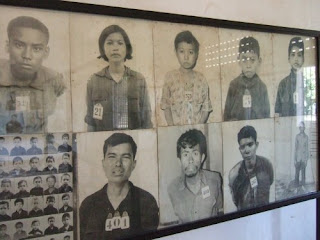
The Khmer Rouge were noted for their unisex black "pajamas." Their typical garb was the peasant outfit of collarless black shirt--baggy trousers and checkered krama (a scarf knotted loosely about the neck). French anthropologist Marie Alexandrine Martin reported that the wearing of brightly colored clothing was prohibited under the Khmer Rouge and that women, young and old, wore black, dark blue, or maroon sampot with short-sleeved plain blouses. Women were forbidden to wear Western-style pants at any time. The conical hat characteristic of the Vietnamese has been adopted to a certain extent by Khmer in the provinces adjacent to Vietnam.
Forigner idea to Angkor wat
Sunday, October 12, 2008
I'd been looking forward to checking out the Angkor temples for quite some time. The temples are known as the 8th wonder of the world for good reason. The whole area is massive. On my first day in Siem Reap myself and Niels rented mountain bikes and made our way to Angkor. We had no idea how huge an area the temples covered. It took us 45 minutes to cycle between some of the temples. The heat and humidity didn't help either. We still managed to check out 5 temples over the course of a long day that lasted from 10 in the morning until sunset. The most famous temple is Angkor Wat. It took us quite a while to walk around the biggest religous building in the world. Incredible to think some of these buildings are one thousand years old. After Angkor Wat we cycled out to Ta Prohm, made famous by Angelina Jolie in Tomb Raider. This temple has a number of huge tress growing inside and around it. The roots wrap themselves around the buildings like snakes. This temple was made all the more authentic by the fact that it was literally falling apart. There are huge stones piled in certain areas, just left where they have fallen. We checked out some smaller temples along the way which were equally as impressive. The sun setting on Angkor Wat as we cycled home is something I will never forget.
Angkor Wat
Angkor Wat
The next day Chris from Boston arrived in Siem Reap. I wanted to give Angkor another visit so we rented a tuk tuk to take us around the temples. We got to see a few temples that were a little further away this way.
1-Angkor Wat
1-Angkor Wat
From Siem Reap I had planned on going straight into Laos. This is a particularly difficult route to take however so I decided to go through Thailand instead. I'm going to make my way to Bangkok before getting a train up north to Chiang Mai.
Traditional Dresses of Cambodian

Khmer Traditional Dresses
Traditional dress in Cambodia is similar to traditional dress in neighboring Laos and Thailand. Sampot is the lower garment worn by either sex. The sampot for urban lower class and peasant women is a tube-skirt (sarong) approximately one and a half meters in length with both ends sewn together and is worn wrapped around the waist and secured with a cloth belt. Women of the middle and upper classes preferred to wear the sampot chang kben on a daily basis until the beginning of the twentieth century. This rectangular piece of cloth is approximately three meters long and one meter wide and is worn by first wrapping the cloth around the waist and stretching the ends away from the body. The outstretched ends are then twisted together and pulled between the legs and toward the back. The ends are tucked into the waist at the back, and the sampot chang kben is lastly fastened with a cloth or metal belt. Women of all social strata wear the sampot chang kben on special occasions such as religious ceremonies and weddings. Men also wear the sampot chang kben, but the traditional textile patterns worn by males differ from those worn by females. Traditionally, neither women nor men wore an upper garment. However, when the French colonial presence grew in Cambodia in the late nineteenth century, both men and women began to wear upper garments.
Even after the French presence in Cambodia from the 1860s onwards, Cambodians continued to wear traditional clothing. The Cambodian royalty and government officials combined the shot silk sampot chang kben (in the appropriate color for the day of the week) with a formal jacket. In the beginning of the twentieth century, Cambodians adopted forms of western style clothing such as a blouse or shirt. Men more readily adopted trousers as the lower garment for daily use, and both sexes continue to wear the sampot chang kben for formal occasions. Lower class and particularly rural women still wear a tube-skirt, but the material may be printed batik-patterned cloth bought at the market rather than hand-woven silk or cotton.
The pidan hol is an example of excellent craftsmanship. It may be presented to a Buddhist temple or hung it in homes to create sacred space around the family's personal shrine. In a temple this textile is hung behind, above, or around the base of, a Buddha image. The narrative motifs of a pidan hol often depict tales of the previous lives of the Buddha.
Cotton Textiles
The various ethnic groups of Cambodia also produce cotton material for religious clothing and other purposes, such as for bedding and for various household textiles. The royal courts also imported Indian chintz with patterns especially for the Southeast Asian market.
The kroma is the all-purpose utility cotton cloth used by either men or women throughout the country as a head or neck scarf, belt, or towel. It is also used as a bag to carry things. This rectangular textile has a checkered pattern, usually blue and white or red and white, with striped ends. Political groups such as the Khmer Rouge have used the kroma to symbolize membership.
The Cham, an Austronesian group, are highly skilled silk weavers who produce cotton tube-skirts or sarongs for both men and women. Three or four hundred years ago, the Cham reportedly used to produce batiks (wax resist-dyed fabrics) in cotton similar to that of their kin in insular Southeast Asia. Cham women weave a checked or plaid cotton sarong for men. Natural or white cotton is important in Cham religious activities; it is worn by Cham priests and used as a sacred object during religious ceremonies.
Other Mon-Khmer and Austronesian minorities living in the northeastern region of Cambodia weave cotton cloth on back strap looms for clothing and domestic use. The groups of both of these linguistic families weave similar textiles by attaching the warp beam of the back strap loom to a tree or part of a house in order the achieve the lengths of woven material needed for their loincloths.
The male loincloth is approximately 20 to 25 centimeters wide and 3 to 7 meters long. It is indigo blue or black with large red warp stripes and smaller yellow and white warp stripes. Supplementary patterns also decorate the stripes. The ends of the loincloth are patterned with red bands with supplementary patterns of animal or plant motifs. Red tassels and lead, glass, or plastic beading sometimes decorate the edges and ends of the loincloth. Men of the various Mon-Khmer linguistic groups sometimes wear a blanket over a shoulder during rituals, but otherwise do not wear an upper garment. Occasionally, men wear a simple tunic made from plant fibers such as bark cloth or banana leaves. These plant-fiber tunics are reported to have been more common when the technology to weave cotton was not familiar to these groups. It is now rare to find clothing made from these fibers. Men of the Jarai and Ede Austronesian minorities wear a collarless shirt of indigo or black cotton adorned with red yarn or metal beads on special occasions.
Women of the different ethnic minorities wear tube skirts. The long tube-skirt is worn tucked in around the breasts and is made from two pieces of material sewn together to form a tube. The shorter version is made from one piece of cloth sewn into a tube and is worn tucked in at the waist. The color scheme of the women's tube-skirts is similar to that of the men's loincloth. Women either do not wear an upper garment or wear a simple tunic made from a single piece of cloth with a hole cut in the middle of the textile for the head and the sides sewn together leaving open spaces for the arms. Ede women add sleeves to the tunic and decorate them with red yarn and metal beading.
As with other Khmer and Cham ethnicities, the minority groups of northeast Cambodia presently reserve traditional dress for special occasions. Textile production in Cambodia has experienced disruption because of political conflict, particularly during the Khmer Rouge regime of the late 1970s. Textile production increased in the calmer conditions at the beginning of the twenty-first century, encouraged by renewed local and foreign interest in hand-woven textiles, particularly in mastering the dyeing and weaving of the pidan hol produced prior to the twentieth century.
Subscribe to:
Posts (Atom)